
When you create AI-Generated content, do you own the copyright? Let’s say you’ve asked AI to create an image, write some website copy, design a graphic, or help develop a workbook. It created something great. So you own it…right?
Definitely Maybe.
And there’s a second question that’s just as important: How do you know the AI didn’t create something that infringes someone else’s copyright?
Copyright law and generative AI are still evolving, but these two questions – whether you can protect what AI creates for you and whether you’re free to use what it creates – are becoming increasingly important for small-business owners.
AI-Generated Content Isn’t an Automatic Barrier to Copyright Protection
Let’s clear up one misconception first. Using AI somewhere in your creative process doesn’t automatically mean your finished work can’t be protected by copyright. The U.S. Copyright Office has confirmed that copyright protection depends upon sufficient human authorship. AI can be used as an assistive tool without destroying copyright protection, and human selection, arrangement, modification, or other creative contributions may be protectable.
You might use AI to brainstorm titles, suggest an outline, generate ideas, identify areas that need clarification, or help edit something you’ve written. Those requests leave plenty of room for human creativity in the process.
But when AI actually generates the expressive material for you, prompting itself doesn’t necessarily make you the author and generally isn’t enough to confer copyright protection. In other words, you actually have to be involved in the creative process!
Why Does That Matter to Your Business?
Suppose you use AI to generate an image for a social media post that you’ll use once. You may decide that having copyright protection in that particular image isn’t especially important.
But what if you are using AI to create your company’s logo? Or the illustrations for a book? Or substantial portions of a book or workbook you’re planning to sell for years? Now the ability to claim exclusive rights in that material matters a lot more.
Could AI-Generated Content Infringe Someone Else’s Copyright?
Don’t assume that something is automatically safe to use simply because AI generated it. An AI tool could produce text or an image that reproduces protected elements of an existing work. And if that happens, “the AI did it” isn’t a legal defense.
Unfortunately, there’s no copyright clearance database where you can upload your AI-generated image or article and receive a definitive green light.
So how are you supposed to know? You can’t eliminate the risk entirely, but you can take some reasonable steps to reduce it.
Start With What You Ask AI to Create
One of the easiest ways to reduce your risk is to avoid asking AI to reproduce or closely imitate someone else’s protected work.
There’s an important difference between:
“Create a whimsical watercolor illustration of a bear having a picnic in the woods.” and “Create something similar to Winnie the Pooh having a picnic in the Hundred Acre Wood.”
Likewise, don’t upload someone else’s photograph, illustration, article, workbook, course materials, or other copyrighted work and asking AI to “make me something like this” or “change this enough that I can use it.”
Copyright owners have the exclusive right to authorize derivative versions of their work. Using AI to create a derivative work of something already existing will not give you copyright ownership. Instead, use AI to help create something new.
Search Before You Publish AI-Generated Content
You can also do some basic screening of the finished AI-generated content before you use it commercially.
For written content, take a few distinctive sentences or phrases from the AI-generated content and search for them online in quotation marks. If the same language appears in an existing article, book, website, or other work, investigate before publishing it.
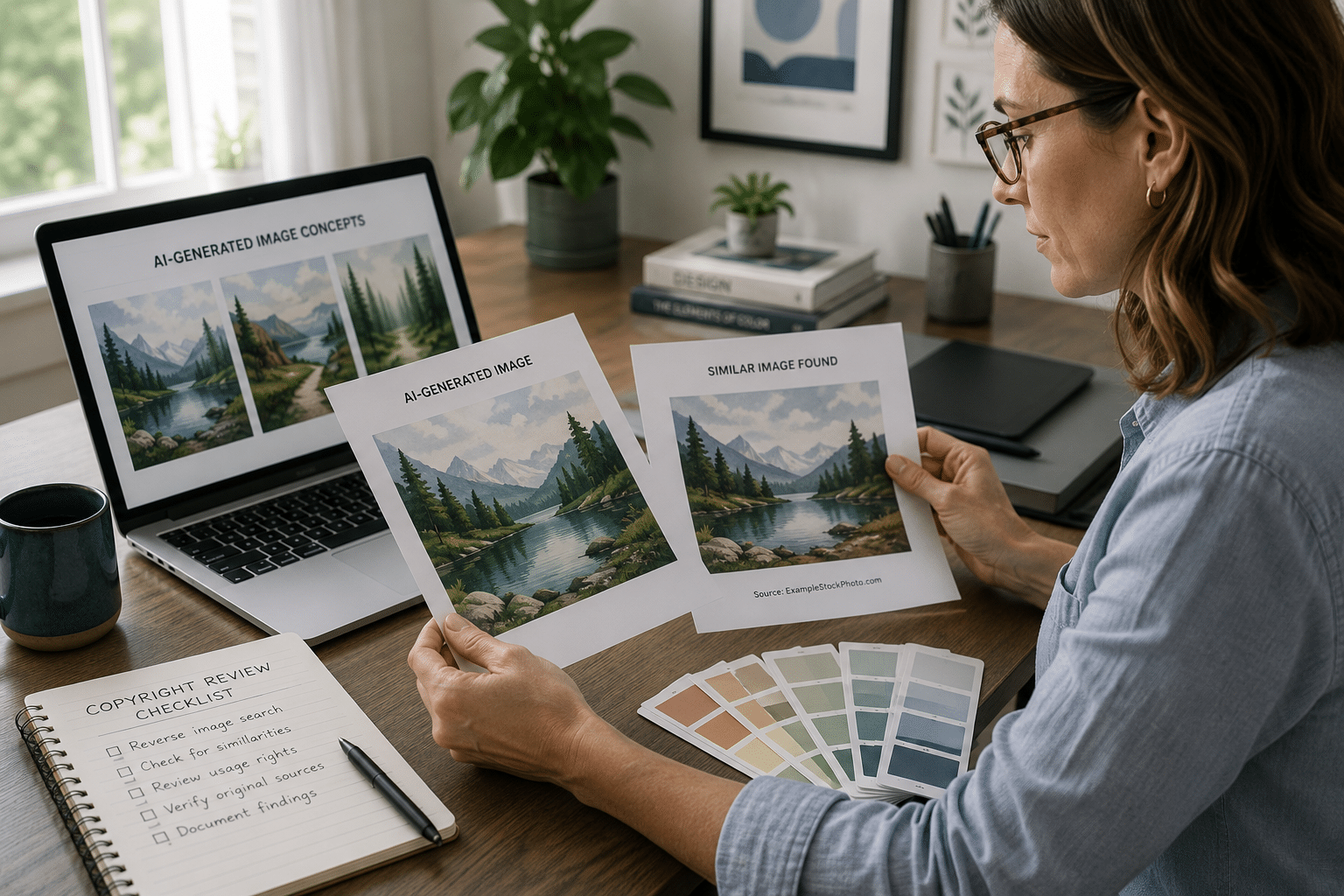
For images, Google Lens provides a free and remarkably easy first screening tool. From a desktop computer, you can use Google’s “Search by Image” feature to upload your AI-generated image. Google Lens will look for the same image and visually similar images appearing elsewhere online.
If your supposedly original AI-generated image produces a strikingly similar existing photograph, illustration, or other artwork, that’s a signal to stop and investigate before using it.
And understand that a reverse image search is a screening tool, not a guarantee. Running a search and finding nothing similar does not prove that the image doesn’t infringe anyone’s copyright. You may need to do further investigation. You may discover that the similarities are perfectly innocent. Or you may decide that the AI output is simply too close to someone else’s work for your comfort. Either way, you know more than you did before running the search.
AI Sounds Messy. If I Hire Someone Else to Create It, Do I Own It Then?
This may be even more important. Suppose you hire a designer to develop original branding for your company. You hire a copywriter to create website content. You hire someone to illustrate a children’s book or develop materials for your course.
What assumptions are you making about what you’re purchasing?
If you believe you’re paying for original human-created work but the contractor is actually generating most of the deliverable using AI, you may not be receiving exactly what you thought you were buying.
That doesn’t mean contractors should never use AI. It means the parties should understand what they’re agreeing to. And it should be documented in your contract.
Depending on the project, your contract may need to address whether generative AI can be used, how it can be used, whether its use must be disclosed, what representations the creator is making about the work, and what ownership rights are actually being transferred
Match Your Due Diligence to the Importance of the Asset
Not every piece of AI-generated content requires the same level of investigation. Think about how you’re going to use the material. Is it a temporary social media graphic? A blog illustration? A paid advertisement? A product you’re going to sell? The artwork for a book? Your signature course materials? A brand asset you’re planning to use for years?
The greater the commercial importance of the work, the more careful you should be about both whether you can protect it and whether someone else might already have rights in it.
Check the AI Provider’s Terms Too
There’s one more place to look before commercially using AI-generated content: the terms governing the AI tool itself. What does the provider say about your rights in the output? Does it make any promises about infringement? Does it offer any protection or indemnification if an output is later alleged to infringe someone else’s rights? Are those protections available to everyone, or only under certain business or enterprise plans? And are there conditions you have to follow to qualify for them?
The answers are different for every AI platform, and the terms can change. If you’re using AI regularly to create commercially important material, you should understand the deal you’ve made with the provider, even if you didn’t realize until now that you made a deal.
AI Can Be a Creative Tool – Just Use It Thoughtfully
For everyday, low-risk content, common sense and reasonable screening are likely enough.
But, for something that’s going to become a valuable business asset, take the extra time to understand how it was created, what rights you have, and whether additional clearance or legal review makes sense.
The goal isn’t to be afraid of creating with AI. It’s to understand what you’re actually getting before you build something important on top of it.